How to Choose the Best 3D PVC Wall Panels
Choosing the best 3d Pvc Wall Panels requires more than comparing patterns, prices, and online photographs. Surface depth, substrate quality, fire performance, moisture resistance, and installation stability all influence long-term value. Grand View Research identifies continued growth in the global PVC wall panels market, supported by demand from commercial interiors, residential renovation, and moisture-prone spaces. However, market growth does not guarantee product quality.
A reliable selection process begins with documented specifications. Check panel thickness, density, dimensional tolerance, and installation temperature limits. A lightweight panel may look attractive, yet flex beside a poorly prepared wall. That small movement can expose joints, especially under strong lighting. Request current test reports for fire classification, such as ASTM E84 or EN 13501-1, where applicable. Also review VOC information and indoor-air-quality documentation. UL Solutions and the U.S. EPA emphasize that material emissions and verified testing matter in healthier interior environments.
Think about the room in practical terms. In a bathroom, sealed edges and stable adhesive performance matter more than dramatic relief. In a hotel corridor, cleanability and impact resistance may outweigh a lower purchase price. Suppliers should explain warranty limits, batch consistency, replacement availability, and maintenance requirements. Product claims can be vague. Sometimes, too vague.
This guide examines how to compare 3d Pvc Wall Panels through measurable performance, installation experience, design suitability, and supplier reliability. It also considers a common mistake: choosing the most impressive texture before checking the wall, climate, and building requirements. A beautiful panel is still a poor choice if it cannot perform in its intended environment.
Define Your Room’s Needs and Wall Panel Goals
Choosing 3D PVC wall panels starts with the room, not the pattern. Measure each wall, including doors, windows, outlets, and ceiling height. Notice how sunlight changes during the day. Glossy panels can exaggerate reflections in a bright room, while dark panels may make a small room feel enclosed. Write it down.
Define the main goal before comparing textures. Is the panel meant to protect a busy hallway, simplify cleaning, hide an uneven surface, or create visual depth? Kitchens and bathrooms need moisture-resistant materials, carefully sealed joints, and adequate ventilation. High-traffic areas need a surface that tolerates repeated cleaning without losing its finish. For bedrooms, softer patterns may feel calmer. Deep relief looks dramatic but can collect dust. That detail is easy to underestimate.
Do not expect PVC panels alone to provide serious sound control. If reducing noise matters, check tested acoustic data for the complete wall system, including backing and installation. I once chose a heavily textured sample because it looked impressive under showroom lights. At home, the shadows felt too strong, and cleaning became awkward. A small mistake, but a useful one. Test samples in the actual room, at different times of day. Check fixing methods, panel weight, moisture limits, surface emissions, and local fire-safety requirements before installation. A qualified installer can also identify weak substrates and hidden electrical risks.
Compare PVC Panel Designs, Textures, and Dimensions
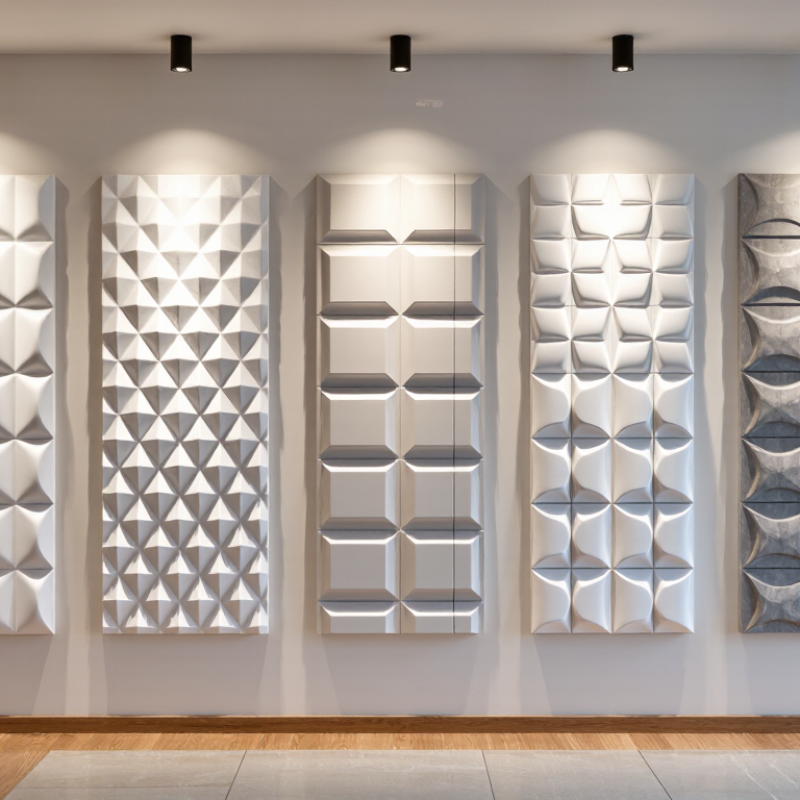
Choosing the best 3D PVC wall panels starts with comparing design, texture, and dimensions. Geometric waves create movement, while stone or wood textures feel calmer. Deep relief catches stronger shadows and suits feature walls. Shallow patterns are easier to clean in busy rooms. I have found that glossy surfaces reveal fingerprints quickly, especially near kitchens. Matte finishes hide small marks better.
Dimensions change both installation speed and visual balance. Large panels reduce seams and create a cleaner appearance on wide walls. Smaller panels work better around windows, outlets, and narrow corners. Check the actual panel thickness, coverage area, and joining method before ordering. A sample can look perfect, yet repeated patterns may feel too busy across ten square metres. My early mistake was measuring only the wall length. Door frames and uneven corners created extra cutting waste.
Tips: Compare samples under daylight and warm lighting. Run your hand across the texture. Sharp edges may collect dust. Order a little extra for mistakes and future repairs. Confirm moisture resistance and cleaning instructions from reliable technical documents. Also review local building requirements, especially for public or commercial interiors. Do not assume every PVC panel has the same fire performance. A cheaper dimension may cost more after awkward cuts. Test one panel first; it may expose alignment problems before the full installation.
Check Installation Methods, Maintenance, and Long-Term Durability
How to Choose the Best 3D PVC Wall Panels
Installation affects performance more than many buyers expect. Before ordering, inspect the wall for moisture, dust, loose paint, and uneven areas. A clean, dry, level surface helps panels sit securely. For smooth indoor walls, construction adhesive may be suitable. Screws or battens provide stronger support on uneven surfaces. Follow the panel maker’s spacing guidance, especially around corners and electrical outlets.
Leave small expansion gaps near floors, ceilings, and wall edges. PVC can expand when temperatures change. I once saw tight-fitting panels buckle beside a sunny window. The mistake looked minor at installation. It became obvious after several hot afternoons. Use a fine-tooth saw, and measure twice. Cut edges should remain hidden under trim whenever possible.
Maintenance should be simple, but the wrong cleaner can dull the surface. Use a soft cloth, warm water, and mild soap. Avoid abrasive pads, strong solvents, and excessive water near joints. Check seams every few months, especially in kitchens and bathrooms. Long-term durability depends on more than thickness. Look for stable color, impact resistance, clear installation guidance, and suitability for the room’s humidity. Very cheap panels may appear attractive initially. Their surfaces can scratch easily, or their joints may separate. I would also test one sample under the room’s actual lighting before covering an entire wall. Sometimes the texture looks impressive online but feels visually harsh in person.
How to Choose the Best 3D PVC Wall Panels
Comparison of common installation methods using practical benchmarks for installation speed, substrate flexibility, maintenance access, moisture suitability, cleaning ease, and long-term durability. Scores range from 1 to 5, with higher values indicating better performance.
Adhesive installation is usually the fastest on smooth, dry surfaces. Mechanical fixing on battens provides better ventilation, leveling, and panel replacement access. Direct screw fixing offers strong retention but requires more visible preparation and accurate alignment. For long-term results, choose moisture-resistant PVC panels, seal exposed edges, and clean the surface with a soft cloth and mild detergent.
Calculate Total Costs and Select the Right Supplier
Choosing 3D PVC wall panels starts with a complete cost calculation, not a low unit price. Measure each wall separately, then multiply length by height. Allow 8–12% for cutting waste, especially around windows, sockets, and corners. Include panels, trims, corner profiles, adhesive, fasteners, delivery, installation, and local taxes. A 20-square-meter room may need 22 square meters of material. Small accessories can quietly change the budget. My first estimate once excluded edge trims. That mistake distorted the comparison.
Request a written quotation with every item separated. Ask whether pricing is per panel, square meter, or carton. Confirm carton coverage and check whether transport fees change by quantity. Calculate the landed cost, not only the advertised price. Inspect samples in daylight and under room lighting. A glossy surface may highlight uneven walls. Technical documents should state thickness, dimensional tolerance, moisture performance, and cleaning limits. For public or commercial spaces, verify applicable fire and installation requirements with qualified local professionals.
Supplier reliability matters after payment too. Evaluate production capacity, lead time, replacement policy, warranty terms, and batch consistency. Ask for recent project references and a sample from current stock. The cheapest supplier may create delays through damaged cartons or inconsistent colors. I also compare communication quality. Clear answers often indicate stronger process control, though this is not proof. Use staged purchasing when possible. Order one test area before committing to the full installation. It costs more initially. It can expose poor adhesion, awkward joints, or unexpected waste before the budget is locked.
How to Choose the Best 3D PVC Wall Panels - Calculate Total Costs and Select the Right Supplier
Comparison based on a 100 m² wall project. Prices are practical market estimates in USD and should be confirmed with a written quotation, sample approval, and delivery terms.
| Panel Option |
Typical Thickness |
Panel Size |
Coverage per Panel |
Estimated Material Price |
Estimated Quantity for 100 m² |
Estimated Material Cost |
Installation Difficulty |
Best Use |
Supplier Selection Score |
| Standard 3D PVC Panel |
5–8 mm |
500 × 500 mm |
0.25 m² |
$4.50–$7.50 per panel |
440 panels
Includes approximately 10% waste |
$1,980–$3,300 |
Easy |
Feature walls, bedrooms, retail displays, and low-moisture interiors |
7.5/10 |
| Deep-Relief 3D PVC Panel |
8–12 mm |
500 × 500 mm |
0.25 m² |
$6.50–$11.00 per panel |
440 panels
Includes approximately 10% waste |
$2,860–$4,840 |
Easy to Moderate |
Reception areas, hospitality interiors, and high-impact decorative walls |
8.2/10 |
| Large-Format 3D PVC Panel |
8–10 mm |
1,200 × 600 mm |
0.72 m² |
$16.00–$28.00 per panel |
153 panels
Includes approximately 10% waste |
$2,448–$4,284 |
Moderate |
Large commercial walls where fewer joints and faster coverage are important |
8.6/10 |
| Water-Resistant Decorative PVC Panel |
6–10 mm |
1,000 × 500 mm |
0.50 m² |
$10.00–$18.00 per panel |
220 panels
Includes approximately 10% waste |
$2,200–$3,960 |
Easy |
Bathrooms, kitchens, utility rooms, and other humid interior areas |
8.4/10 |
| Fire-Performance PVC Panel |
8–12 mm |
1,200 × 600 mm |
0.72 m² |
$22.00–$38.00 per panel |
153 panels
Includes approximately 10% waste |
$3,366–$5,814 |
Moderate |
Public buildings, corridors, offices, and projects requiring documented fire performance |
9.0/10 |
| Printed or Laminated 3D PVC Panel |
6–10 mm |
1,000 × 500 mm |
0.50 m² |
$14.00–$26.00 per panel |
220 panels
Includes approximately 10% waste |
$3,080–$5,720 |
Easy to Moderate |
Hospitality, retail, themed interiors, and projects requiring a specific visual finish |
8.0/10 |
| Estimated project cost range before freight, taxes, accessories, and installation labor |
$1,980–$5,814 for 100 m² |
Cost calculation method:
Estimated quantity = wall area × 1.10 ÷ coverage per panel. The additional 10% allows for cutting, pattern alignment, and installation waste.
Supplier checklist:
Request a physical sample, confirm panel dimensions and thickness tolerance, ask for test documentation when required, verify moisture and fire claims, compare packaging and replacement policies, and obtain a complete quotation that separates product price, accessories, freight, taxes, and delivery time.
Practical recommendation:
Choose the lowest total installed cost that still meets the project’s moisture, fire-performance, appearance, durability, and delivery requirements—not simply the lowest panel price.

 Hot Selling