Shandong Xiangying New Materials Technology Co., Ltd.

 Hot Selling
Leave Your Message
Shandong Xiangying New Materials Technology Co., Ltd.
Global buyers are no longer choosing a Wall Panel for appearance alone. Moisture, fire performance, insulation, installation speed, and maintenance now shape purchasing decisions. Wall panels must also suit local climates, labor skills, and project budgets.
Grand View Research reports that the global wall panels market was valued at approximately USD 14 billion in 2023. Its study expects continued growth through 2030, supported by commercial construction, renovation, and demand for energy-efficient envelopes. The International Energy Agency also states that buildings consume about 30% of global final energy. That figure gives insulation and thermal bridging greater importance. However, market forecasts differ. Buyers should check regional data before committing to large volumes.
Dr. Joseph Lstiburek, a recognized building-science expert, said, “There is no such thing as a perfect wall.” This practical warning applies to every panel category. A stone-look PVC panel may simplify cleaning, but it will not replace a tested rainscreen system. A mineral wool panel can improve fire resistance, yet installation details still matter. Sandwich panels may reduce construction time, though joints can become weak points. Small mistakes become visible around windows, corners, and service penetrations.
This guide compares ten Wall Panel types for international purchasers. It considers material behavior, installation conditions, lifecycle value, and visual use. Some recommendations remain imperfect. Product names, test standards, and performance claims vary by market. Buyers should request current technical sheets, independent test results, samples, and warranty terms. A good panel is not merely attractive. It must perform after the first rainy season, the first repair, and years of daily use.
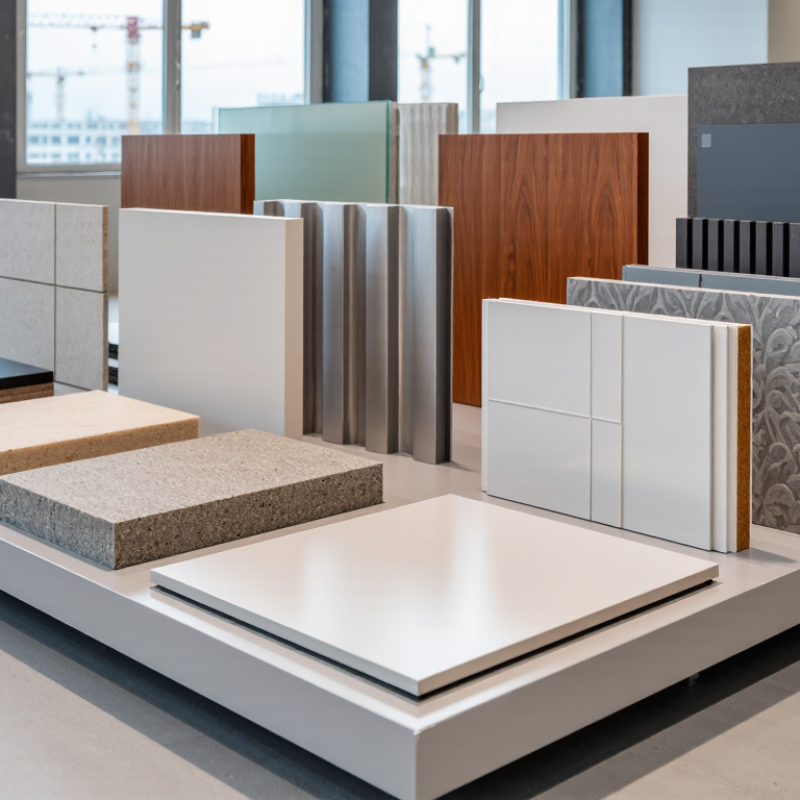
Top 10 Wall Panel Types for Global Buyers
Global buyers should define wall panels by material, core, purpose, and code. Common choices include gypsum, cement board, calcium silicate, metal, PVC, wood, aluminum composite, mineral wool sandwich, PIR sandwich, and EPS sandwich panels. Each behaves differently. Gypsum suits dry interiors, while cement and calcium silicate tolerate moisture better. Mineral wool supports fire resistance and acoustic control. PIR and EPS improve thermal performance, but their fire behavior requires careful verification. Decorative PVC may fit clean rooms, yet it can perform poorly near heat sources.
Use changes the specification. Exterior façades need weather resistance, drainage, impact strength, and stable coatings. Interior partitions need sound control, surface durability, and easy repair. According to UNEP’s 2023 Global Status Report for Buildings and Construction, buildings consumed about 32% of global energy and produced 34% of global carbon dioxide emissions in 2022. Therefore, compare declared thermal values, recycled content, service life, and transport weight. “Green” is not always green.
Code evidence must match the installation country. European projects may require EN 13501-1 fire classification, while North American projects often reference ASTM E84 or other approved assemblies. A core test alone is insufficient. Joint design matters. Site reviews frequently find gaps around doors, fasteners, and penetrations. Those small details can change smoke and fire performance. A report issued in one jurisdiction may not satisfy another. Confirm local requirements, tested thickness, fixing method, humidity exposure, and maintenance conditions before ordering.
| No. | Wall Panel Type | Primary Material | Core or Structure | Typical Applications | Common Global Code and Standard References | Key Buyer Consideration |
|---|---|---|---|---|---|---|
| 1 | Gypsum Wallboard | Gypsum plaster core with paper or glass-fiber facings | Solid gypsum board; available in standard, moisture-resistant, impact-resistant, and fire-resistant grades | Interior partitions, ceilings, shaft walls, residential and commercial fit-outs | EN 520; ASTM C1396/C1396M; fire performance commonly assessed under EN 13501-1 or ASTM E84; fire-resistance assemblies require tested system designs | Low cost and easy installation; joint treatment and the complete wall assembly affect fire and acoustic performance |
| 2 | Cement-Bonded Particle Board | Wood particles bonded with hydraulic cement | Dense, homogeneous cement-mineral matrix reinforced by wood fibers or particles | Wet-area partitions, façades, floor and wall sheathing, modular construction | EN 634 series; reaction-to-fire classification under EN 13501-1; structural or sheathing use must meet local wind, moisture, and load requirements | Good moisture and impact resistance; heavier than conventional gypsum and requires suitable fixing systems |
| 3 | Fiber-Cement Board | Portland cement, mineral fillers, and cellulose or synthetic fibers | Non-combustible or limited-combustibility cementitious matrix, depending on formulation | External cladding, rainscreen systems, wet rooms, façades, and high-humidity interiors | EN 12467; ASTM C1186; fire classification commonly referenced through EN 13501-1 or ASTM E136/E84 as applicable | Weather-resistant and dimensionally stable; panel joints, sealants, ventilation cavities, and subframes are critical |
| 4 | Mineral Wool Sandwich Panel | Coated steel or aluminum facings | Stone wool or glass mineral wool insulation core | Industrial buildings, warehouses, cold or warm enclosures, façades, and fire-sensitive facilities | EN 14509 for factory-made double-skin metal-faced panels; EN 13501-1 for reaction to fire; fire-resistance ratings require tested assemblies under local codes | Strong fire and acoustic performance; higher weight may increase structural and installation requirements |
| 5 | PIR or PUR Insulated Sandwich Panel | Pre-finished steel or aluminum outer skins | Rigid polyurethane or polyisocyanurate foam insulation core | Factories, logistics buildings, agricultural buildings, temperature-controlled rooms, and commercial façades | EN 14509; EN 13501-1; ASTM C1289 may apply to faced polyisocyanurate insulation products; local requirements govern façade fire safety and fire barriers | High thermal efficiency at relatively low thickness; verify joints, smoke behavior, fire stops, and approved assembly ratings |
| 6 | Aluminum Composite Panel | Aluminum alloy sheets with factory-applied finish | Polymer, mineral-filled, or non-combustible mineral core between aluminum skins | Ventilated façades, soffits, signage backgrounds, canopies, and architectural features | EN 13501-1; ASTM E84 and NFPA 285 may be relevant in North American façade assemblies; EN 1396 covers coil-coated aluminum products | Lightweight and formable; core type, cavity barriers, attachment method, and façade height can affect approval |
| 7 | High-Pressure Laminate Panel | Decorative paper and kraft paper impregnated with thermosetting resins | Compact solid laminate or thin laminate bonded to a substrate | Interior wall protection, washrooms, healthcare interiors, hospitality, retail, and ventilated façades | EN 438; EN 13501-1 for fire classification; ASTM E84 or project-specific fire tests may apply; exterior systems require weather and wind-load assessment | Durable decorative surface and easy cleaning; edge detailing, moisture protection, and substrate movement must be controlled |
| 8 | PVC Decorative Wall Panel | Rigid or foamed polyvinyl chloride, often with a printed or laminated surface | Hollow, foamed, or cellular PVC structure | Bathrooms, utility rooms, retail interiors, temporary fit-outs, and decorative renovations | Fire performance commonly evaluated under EN 13501-1 or ASTM E84; applicable building, smoke, hygiene, and chemical-resistance requirements vary by use | Water-resistant and lightweight; confirm smoke emission, fire classification, temperature limits, and suitability for occupied spaces |
| 9 | Plywood Wall Panel | Cross-laminated wood veneers bonded into sheets | Multiple veneer plies with alternating grain directions | Interior feature walls, structural sheathing, modular buildings, cabins, and protected exterior applications | EN 636 for plywood use classes; EN 13986 for wood-based panels in construction; structural design and reaction-to-fire requirements follow local codes | High strength-to-weight ratio; grade, adhesive durability, formaldehyde class, moisture exposure, and fire treatment should be specified |
| 10 | Solid Wood or Engineered Timber Panel | Solid timber, finger-jointed wood, or laminated timber elements | Solid wood boards, edge-glued boards, or cross-laminated timber layers | Interior wall finishes, exposed structural walls, prefabricated buildings, and low-carbon construction | EN 16351 for cross-laminated timber; EN 13986 for wood-based panels where applicable; Eurocode 5 or equivalent national timber design codes; fire performance under EN 13501-1 or local test methods | Renewable and visually attractive; moisture content, biological durability, charring design, connections, and fire protection require careful engineering |
Note: The listed standards are common international or regional references. Final compliance depends on the destination country's building code, project type, installation method, fire strategy, structural design, and tested wall assembly.