Shandong Xiangying New Materials Technology Co., Ltd.

China has become a major source of architectural wood products, including decorative Veneer Wall Panels. Its manufacturers serve hotels, offices, retail spaces, and high-end residential projects worldwide. Yet choosing a reliable supplier requires more than browsing attractive product photos.
This guide examines ten notable Chinese manufacturers through practical purchasing criteria. These include veneer quality, panel construction, surface consistency, customization, production capacity, and export experience. We also consider factory certifications, quality-control procedures, packaging methods, and communication during sampling. A well-made panel should show balanced grain, clean edge finishing, stable dimensions, and careful color matching across multiple sheets. Small details matter. They affect installation time and the final visual result.
No ranking is permanent. Market information changes, and public factory data is not always complete. A polished showroom can also hide inconsistent production standards. Therefore, buyers should request current samples, test technical specifications, and confirm fire, moisture, and emissions requirements for each project. Site visits or independent inspections may reveal more than a sales brochure. This overview aims to offer a useful starting point, not an unquestionable verdict. The strongest manufacturer may differ according to budget, design goals, project scale, and required delivery schedule. Careful comparison remains essential.
China Top 10 Veneer Wall Panel Manufacturers
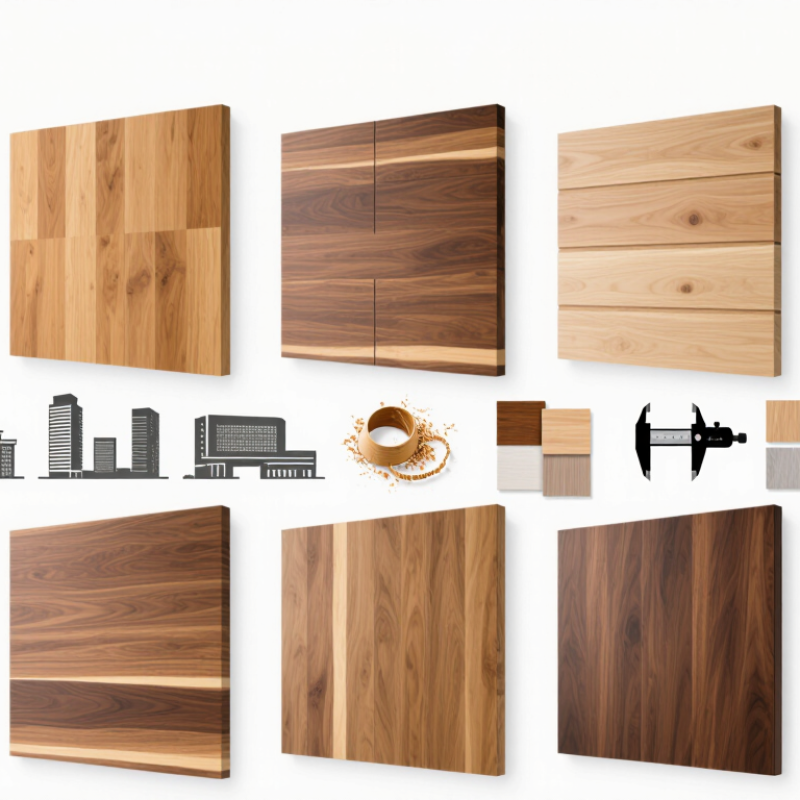
Veneer wall panels are decorative boards covered with a thin layer of natural wood. They bring grain, warmth, and texture to offices, hotels, homes, and retail spaces. The core may use plywood, MDF, or another engineered board. The visible veneer can be oak, walnut, ash, or other timber species. Each panel should be checked for stable bonding, even color, and clean edge finishing.
China matters because its manufacturers combine furniture-making skills with large-scale panel production. Many factories offer custom sizes, perforated surfaces, acoustic backing, and different fire-performance options. They also support coordinated production for walls, ceilings, doors, and built-in furniture. However, production capacity does not guarantee reliable quality. Some samples look excellent, while later batches show color variation or weak edges. This is where careful verification becomes essential.
Tips: Request a physical sample and technical datasheet before ordering. Confirm veneer thickness, core material, moisture resistance, formaldehyde testing, and installation details. Ask how the factory controls color matching between panels. Review factory photos, inspection records, and packaging methods. A lower quotation may reduce cost, but it can also reflect thinner veneer or fewer quality checks. I still find this difficult to judge from documents alone; independent inspection remains a sensible step for larger projects.

Veneer wall panels combine a thin natural-wood face layer with a stable engineered substrate. The representative thicknesses below reflect common commercial construction ranges and do not represent any individual company or brand.
Natural veneer is typically much thinner than the substrate, while MDF, plywood, or particleboard provides dimensional stability and installation strength. This combination helps explain the popularity of veneer wall panels in interior projects manufactured and supplied from China.
China Top 10 Veneer Wall Panel Manufacturers
How to Define and Rank the Top 10 Manufacturers
Ranking China’s top veneer wall panel manufacturers requires more than checking factory size or export volume. A reliable assessment begins with verified production experience, material knowledge, and consistent project delivery. Review factory years, annual capacity, veneer sourcing, drying methods, and panel pressing records. Factory visits can reveal details that brochures hide, such as uneven storage conditions or weak quality controls.
Performance should carry the greatest weight. Test samples for surface flatness, bonding strength, moisture resistance, color consistency, and edge stability. Ask for inspection reports and traceable batch records. Experienced manufacturers should explain substrate choices, fire performance, formaldehyde control, and installation limits in clear language. They should not promise impossible results.
Service matters too.
Score communication speed, sample accuracy, packaging quality, technical drawings, and after-sales response. A practical ranking may assign 30% to product quality, 20% to production reliability, 15% to technical expertise, 15% to certifications, 10% to delivery performance, and 10% to service. Independent testing and verified customer references improve credibility. However, rankings still contain uncertainty. A large factory may not suit small custom orders, while a smaller producer may offer stronger supervision. Recheck evidence every year. A polished showroom is not enough.
| No. | Ranking Dimension | Weight | Measurable Benchmark | Recommended Verification Evidence | Scoring Guidance |
|---|---|---|---|---|---|
| 1 | Manufacturing Capacity and Stability | 15% | Consistent production capability, documented production lines, stable lead times, and sufficient capacity for repeat commercial orders. | Factory audit, production-line records, monthly capacity statement, lead-time history, and recent order references. | 5 = large and consistently documented capacity; 3 = adequate capacity; 1 = limited or unverifiable capacity. |
| 2 | Panel and Substrate Quality | 15% | Uniform veneer appearance, stable panel dimensions, reliable bonding, controlled moisture content, and low defect rates. | Third-party inspection reports, incoming-material controls, internal QC records, sample approval reports, and batch traceability. | 5 = documented multi-stage quality control; 3 = standard inspection system; 1 = inconsistent or undocumented control. |
| 3 | Environmental and Formaldehyde Compliance | 15% | Products should be tested against the requirements of the target market. For example, EN 717-1 uses a chamber-emission method, while CARB Phase 2 and TSCA Title VI apply formaldehyde-emission limits to regulated composite wood products. | Current laboratory test reports, product-specific declarations, chain-of-custody documents, and reports identifying the tested substrate and adhesive system. | 5 = current product-specific reports for the target market; 3 = partial documentation; 1 = unsupported environmental claims. |
| 4 | Product Range and Customization | 10% | Ability to provide different veneer species, colors, textures, panel sizes, edge details, perforations, grooves, acoustic options, and fire-rated constructions where required. | Technical catalog, approved samples, customization workflow, minimum-order details, and engineering drawings. | 5 = broad and repeatable customization; 3 = standard options with limited modification; 1 = mostly fixed products. |
| 5 | Technical Performance | 10% | Performance should match the application, including fire reaction, acoustic absorption, dimensional stability, surface durability, and installation compatibility. | Test reports to applicable project standards, technical data sheets, installation instructions, and system drawings. | 5 = complete project-relevant test package; 3 = basic performance data; 1 = no verifiable technical information. |
| 6 | Quality Management System | 10% | A formal quality system should control purchasing, production, inspection, corrective actions, document management, and product traceability. | Valid ISO 9001 certificate when applicable, quality manual, inspection checklists, nonconformance records, and corrective-action reports. | 5 = audited and consistently implemented system; 3 = documented internal procedures; 1 = informal quality management. |
| 7 | Export and Project Experience | 8% | Experience with international packaging, export documentation, local building requirements, installation coordination, and project-based delivery. | Redacted project list, shipping records, export documentation samples, installation manuals, and customer references. | 5 = extensive documented international project experience; 3 = some export experience; 1 = mainly unverified domestic experience. |
| 8 | Supply-Chain Transparency | 7% | Clear information about veneer sourcing, substrate suppliers, adhesive systems, batch identification, and responsible material procurement. | Supplier declarations, material safety data, purchase specifications, traceability records, and applicable forestry or chain-of-custody documents. | 5 = transparent and traceable supply chain; 3 = partial supplier information; 1 = unclear material origin. |
| 9 | Delivery, Packaging, and After-Sales Support | 5% | Reliable delivery schedules, moisture-protective packaging, damage-reduction procedures, installation assistance, warranty terms, and complaint handling. | Packaging specifications, on-time delivery records, warranty policy, replacement procedure, and service-response commitments. | 5 = structured logistics and responsive service; 3 = standard service; 1 = unclear delivery or warranty process. |
| 10 | Commercial Value and Cost Transparency | 5% | Evaluation should consider total delivered cost, material yield, finishing quality, packaging, installation requirements, warranty exposure, and payment terms rather than unit price alone. | Comparable quotations, detailed bills of materials, freight assumptions, sample approval terms, warranty conditions, and change-order policy. | 5 = transparent and competitive total cost; 3 = acceptable but incomplete pricing; 1 = unclear exclusions or unstable pricing. |
China’s top ten veneer wall panel manufacturers represent different strengths rather than one identical production model. One focuses on natural oak veneers and careful grain matching. Another specializes in fire-rated panels for hotels and public interiors. A third serves residential projects with flexible thickness and color options. The fourth operates large pressing lines, supporting stable volume orders. The fifth is known for moisture-resistant substrates in humid regions. The sixth combines veneer panels with acoustic backing. The seventh emphasizes custom perforation and CNC shaping. The eighth supplies lightweight panels for renovation work. The ninth develops low-emission adhesives and formaldehyde testing procedures. The tenth supports export projects with detailed packing, labeling, and installation documents.
A reliable manufacturer should provide more than attractive samples. Buyers should examine veneer origin, core composition, panel flatness, bonding strength, surface repair, and batch consistency. Factory visits can reveal practical details, such as clean storage areas, calibrated presses, and protected veneer stacks. Several established producers use laboratory testing before shipment, while others depend heavily on external reports. That difference deserves attention. A certificate alone does not prove every batch performs equally.
These manufacturers also differ in communication and project control. Experienced teams confirm drawings, edge details, panel dimensions, and installation conditions before production. They usually send approval samples and record color variation. Natural veneer is never perfectly uniform. That is part of its character, but it can also create disputes. Some suppliers explain this clearly; others could improve. Lead times may change when timber availability, custom finishes, or inspection requirements shift. Careful buyers compare technical evidence, production experience, and after-sales responsiveness before selecting a supplier.
China’s top veneer wall panel manufacturers typically offer oak, walnut, ash, and smoked veneer options. Each species brings a different grain pattern, color depth, and maintenance requirement. Real wood veneer creates warmth, while engineered veneer provides more consistent matching across large walls. Ask for physical samples, not only digital images. Screens can hide uneven tones.
Design choices include fluted panels, acoustic slats, curved surfaces, and plain flush boards. A hotel lobby may need bold grain direction, while a private study may suit narrow vertical strips.
Custom sizing can reduce joints around columns, doors, and lighting tracks. Confirm the panel core, surface finish, edge treatment, and installation method before approving drawings. Details matter.
Reliable suppliers should provide test reports and clear production records. Check formaldehyde emissions, fire performance, moisture resistance, bonding strength, and dimensional stability against the project’s applicable standards. Request sample approval and a written tolerance range. I have seen beautiful panels fail because the wall was damp or the substrate was uneven. That lesson is easy to overlook. Color variation is also natural, and perfect uniformity may be unrealistic. A capable manufacturer should explain limitations honestly, offer replacement procedures, and document quality checks from veneer selection to final packing.
Comparing veneer wall panel suppliers requires more than checking catalog photos. Inspect the veneer species, thickness, moisture content, and surface consistency. Ask whether the core uses plywood, MDF, or another substrate. Each choice affects stability, weight, and installation. Request recent test reports for formaldehyde emissions, fire performance, and bonding strength. Documents matter. However, samples reveal details that certificates cannot show, including open pores, uneven color, and weak edge finishing.
During sourcing, compare suppliers through the same written specification. Include panel size, veneer grade, backing structure, edge treatment, packaging, and acceptable color variation. Confirm production capacity and realistic lead times. A low quotation may exclude crating, replacement panels, or inspection costs. In my experience, clear drawings prevent more problems than polished sales presentations. Still, judgment can fail. A supplier with excellent samples may struggle with large-volume consistency. Order a pilot batch before approving full production.
Tips: Visit the factory when possible, or arrange a live video inspection. Watch how veneers are stored and pressed. Ask for photos from recent projects, not only showroom images. Check how defects are recorded and corrected. Discuss payment terms carefully, and keep every requirement in the contract. Communication speed is useful, but technical accuracy matters more. Do not choose the cheapest option automatically. A slightly higher price may provide better core materials, safer packaging, and fewer installation delays.