What Are the Top China 3D Wall Panel Suppliers?
China’s 3d Wall Panel industry is expanding with interior renovation, hospitality projects, and commercial fit-outs. Grand View Research estimates that the global wall panels market reached approximately USD 13.86 billion in 2023. It also projects steady growth through 2030. Mordor Intelligence reports a different market baseline and forecasts a 6.37% compound annual growth rate from 2025 to 2030. The gap matters. These reports use different product definitions, and few separate 3d panels from broader wall-panel categories.
For buyers, supplier quality involves more than attractive catalog images. Reliable manufacturers should show factory capacity, material specifications, test documentation, and export experience. Key checks include PVC, bamboo fiber, MDF, and polyurethane composition. Fire performance matters. So do VOC emissions, moisture resistance, acoustic behavior, and dimensional stability. A sample should reveal edge quality, surface consistency, mounting accuracy, and packaging strength. A damaged corner after sea transport is not a minor issue.
Industrial designer Karim Rashid has said, “Design is a language, not a style.” That principle applies to 3d Wall Panel selection. A supplier should translate a visual concept into repeatable production, not merely offer impressive renderings. This guide examines leading China suppliers through customization, certifications, minimum order quantities, lead times, and communication practices. It also recognizes an uncomfortable truth: no supplier is automatically best for every project. Some excel at hotel-scale orders, while others handle smaller custom batches more carefully. Specification sheets can still hide weaknesses. Direct sampling remains essential.
What Are 3D Wall Panels and Why Are They Used?
What Are 3D Wall Panels and Why Are They Used?
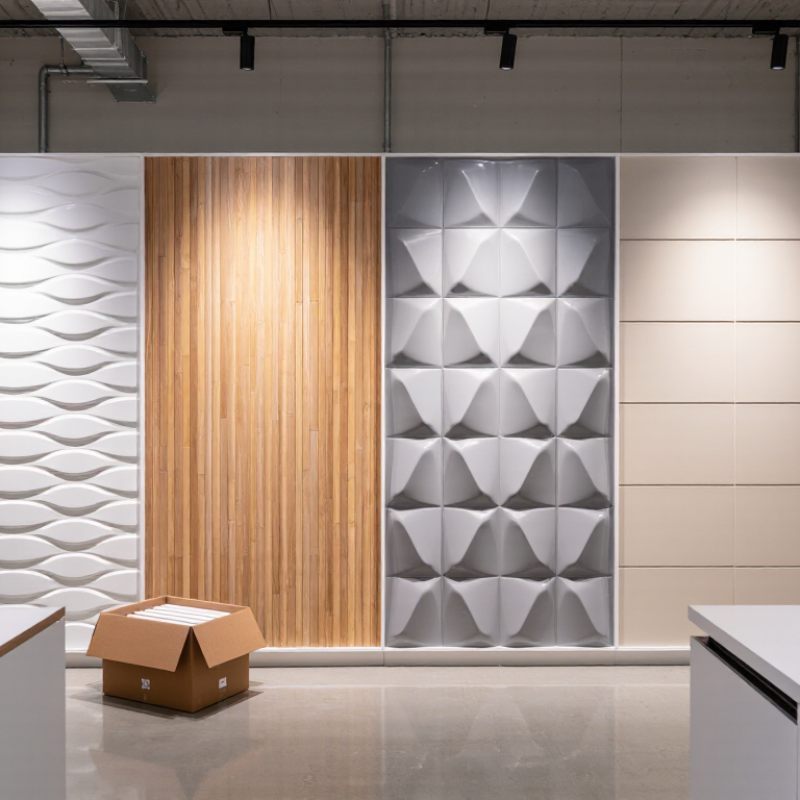
3D wall panels are molded or carved surfaces with repeating waves, lines, tiles, or geometric reliefs. They add depth without rebuilding a wall. Common materials include gypsum, PVC, MDF, bamboo fiber, and recycled polymers. Designers use them to create a textured feature wall in offices, hotels, restaurants, and homes. The shadows change as daylight moves across the surface. Small rooms can feel more structured, but heavy patterns may feel visually crowded.
Their value is not only decorative. Some panels help reduce echo when paired with suitable backing and correct installation. However, a textured face alone does not guarantee acoustic control. ASTM C423 testing and a published Noise Reduction Coefficient are more reliable indicators. The U.S. Environmental Protection Agency reports that indoor pollutant levels can be two to five times higher than outdoor levels. Low-emitting materials and adhesives therefore deserve attention. This point is often overlooked.
Tips:
Request fire, moisture, and acoustic test documents before purchasing. Check the panel’s weight and wall compatibility. Leave expansion gaps where manufacturers require them. A sample under actual lighting is useful. Honestly, 3D panels are not perfect; dust can collect in deep grooves, and repairs may look uneven. Professional measurements reduce those risks.
Sources: U.S. EPA Indoor Air Quality guidance; ASTM C423; ASHRAE Handbook—HVAC Applications.
What Defines a Reliable China 3D Wall Panel Supplier?
What Defines a Reliable China 3D Wall Panel Supplier?
A reliable supplier proves performance before discussing price. Ask for material composition, panel density, moisture resistance, fire classification, and VOC test results. These documents should show the laboratory name, test date, and applicable standard. The Freedonia Group’s wallcovering industry analysis identifies renovation and commercial interiors as major demand drivers. This makes batch consistency especially important. One warped panel can interrupt an entire hotel corridor.
Production evidence matters more than polished showroom photos. Request a current factory video, sample approval record, and quality-control checklist. Check whether workers inspect edges, embossing depth, color, and package damage. ISO’s latest global survey reports more than one million ISO 9001 certificates worldwide. Certification helps, but it does not replace factory audits or independent testing. I have seen impressive samples fail during humid storage. That possibility deserves honest discussion.
Tips:
Order samples from two production batches. Leave them in your project’s real temperature and humidity conditions. Measure thickness with a caliper, not your eyes. Confirm lead time, replacement policy, export packaging, and payment milestones in writing. A dependable supplier will explain limitations clearly. Sometimes, the cheapest quotation hides weaker backing material or thicker packaging losses. Reliability is not perfection; it is traceable evidence, repeatable production, and fast responsibility when something goes wrong.
Which China Suppliers Lead in 3D Wall Panel Manufacturing?
The leading China suppliers in 3D wall panel manufacturing combine material control with practical factory experience. Many operate production lines for PVC, bamboo fiber, polyurethane, or mineral-based panels. Their strongest advantage is often flexible customization. Buyers can request specific textures, panel sizes, colors, and fire-performance requirements. A reliable supplier should provide physical samples before confirming large production.
Experienced manufacturers use CNC molds and controlled pressing equipment to keep patterns consistent. Small differences can still appear between samples and mass production. That detail deserves honest discussion. Ask for thickness tolerance, density data, moisture resistance, and surface coating information. Suppliers with in-house testing usually respond with clearer documents. They may also explain packaging methods, carton strength, and loading plans for overseas delivery.
Quality leadership is not measured by photographs alone.
Factory audits, production videos, inspection records, and independent test reports offer stronger evidence. Look for suppliers familiar with recognized building-material standards in the destination market. Some factories specialize in large commercial projects, while others handle smaller custom orders more carefully. Communication speed matters too, but fast replies do not always mean dependable control. A careful supplier confirms drawings, approves color samples, and records every change before production. Mistakes can happen. The real difference is how openly the factory identifies and corrects them.
How Can Buyers Compare China 3D Wall Panel Suppliers?
How Can Buyers Compare China 3D Wall Panel Suppliers?
Comparing China 3D wall panel suppliers requires more than checking catalog prices. Request the same specifications from every factory. Include panel size, thickness, material, surface finish, packaging, and order quantity. A useful scorecard should separate product cost from tooling, inspection, shipping, and installation costs. The United Nations Environment Programme reported that buildings consumed over 34% of global energy in 2022. Therefore, buyers should ask for density, recycled content, VOC data, and thermal performance. These details affect both project compliance and long-term operating conditions.
Request recent test reports, not copied certificates. Check whether reports identify the actual factory and matching product code. For fire performance, confirm the required local standard, such as ASTM E84 or EN 13501-1. Ask for production samples from different batches. Color variation can appear after installation. It is easy to overlook this risk. Evaluate moisture resistance, edge quality, dimensional tolerance, and adhesive compatibility. Also compare monthly capacity, lead time, carton protection, and response speed. The World Bank’s 2023 Logistics Performance Index shows that international delivery reliability varies significantly across markets. A cheaper quote may become expensive after delays or damaged cartons. Factory audits, video inspections, and independent pre-shipment checks improve reliability. Still, no scorecard is perfect. Buyers may overvalue polished samples and undervalue after-sales handling. A small pilot order exposes weaknesses before a full container commitment.
How Can Buyers Compare China 3D Wall Panel Suppliers?
Use a weighted evaluation model rather than comparing price alone. Product quality, certifications, customization capability, lead time, MOQ, price transparency, and after-sales support are practical criteria for screening suppliers. The percentages below are suggested purchasing weights and are not rankings of any specific company or brand.
What Should Buyers Check Before Placing an Order?
Buying 3D wall panels from China requires more than comparing catalog prices. Check the panel material, density, thickness, surface finish, and dimensional tolerance. Ask for physical samples, not only digital photos. A panel should feel consistent across its edges and corners. Small gaps can become obvious after installation.
Request current test reports for fire performance, emissions, moisture resistance, and other requirements relevant to your project location. Confirm who issued each report and whether it matches the exact panel model. Review production capacity, minimum order quantity, lead time, and packaging details. A reliable supplier should explain how panels are protected with corner guards, foam, or reinforced cartons. Ask for photos of packed shipments.
Clear communication matters. Send drawings with measurements, colors, textures, and installation conditions. Request a written quotation that separates panel costs, tooling, packaging, and delivery. Payment terms should be documented carefully. I have learned that a low unit price can hide expensive replacement work. It is an easy detail to miss.
Before ordering, inspect the factory or arrange an independent inspection when practical. Check whether quality control happens during production, not only before shipment. Discuss replacement procedures for damaged or mismatched panels. Confirm warranty limits in writing. Suppliers may promise flexibility, yet vague promises are difficult to use later. Keep approved samples and signed specifications as your reference.

 Hot Selling